Executive Summary
Telecommunications operators have spent the last decade investing in automation, observability, AIOps, and digital customer service. Yet one problem remains stubbornly expensive: resolving customer issues still requires humans to navigate fragmented systems, correlate disconnected data, interpret runbooks, and coordinate operational teams.
The challenge is no longer collecting more telemetry. Modern networks already generate enormous volumes of alarms, logs, metrics, topology data, and customer interactions.
The challenge is converting that information into autonomous action.
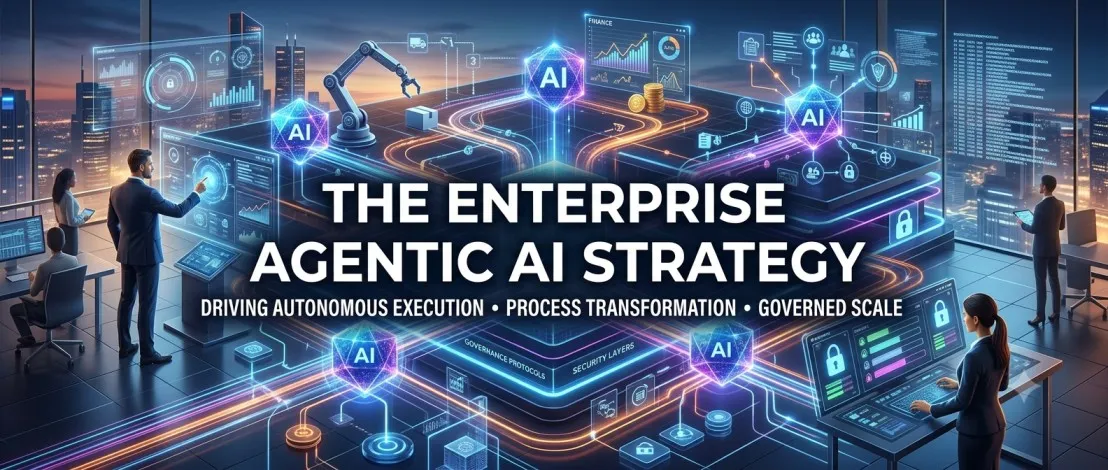
Agentic AI represents a fundamental shift in enterprise architecture. Instead of building a larger chatbot or a smarter copilot, organizations design a network of specialized AI agents that reason, collaborate, access enterprise systems, and execute governed business actions.
This article presents a production-ready reference architecture for building such a platform on Google Cloud using a telecom operations scenario.
Rather than discussing individual cloud services, we examine how they combine into an enterprise operating model capable of autonomous diagnosis, decision-making, and remediation.
A New Operating Model for Telecom
Consider one of the most common customer complaints:
"My internet is slow."
Although simple, this request often triggers a surprisingly complex operational process.
A support engineer may consult customer records, network topology, OSS systems, historical incidents, maintenance schedules, monitoring dashboards, and field-service information before identifying the root cause.
Every additional handoff increases operational cost while extending Mean Time To Resolution (MTTR).
The traditional operating model depends on humans acting as the integration layer between disconnected enterprise systems.
Agentic AI changes this assumption.
Instead of asking engineers to assemble information manually, specialized AI agents collaborate across enterprise platforms, forming a digital operations team capable of diagnosing and resolving many incidents autonomously while escalating only high-risk decisions.
The Reference Architecture
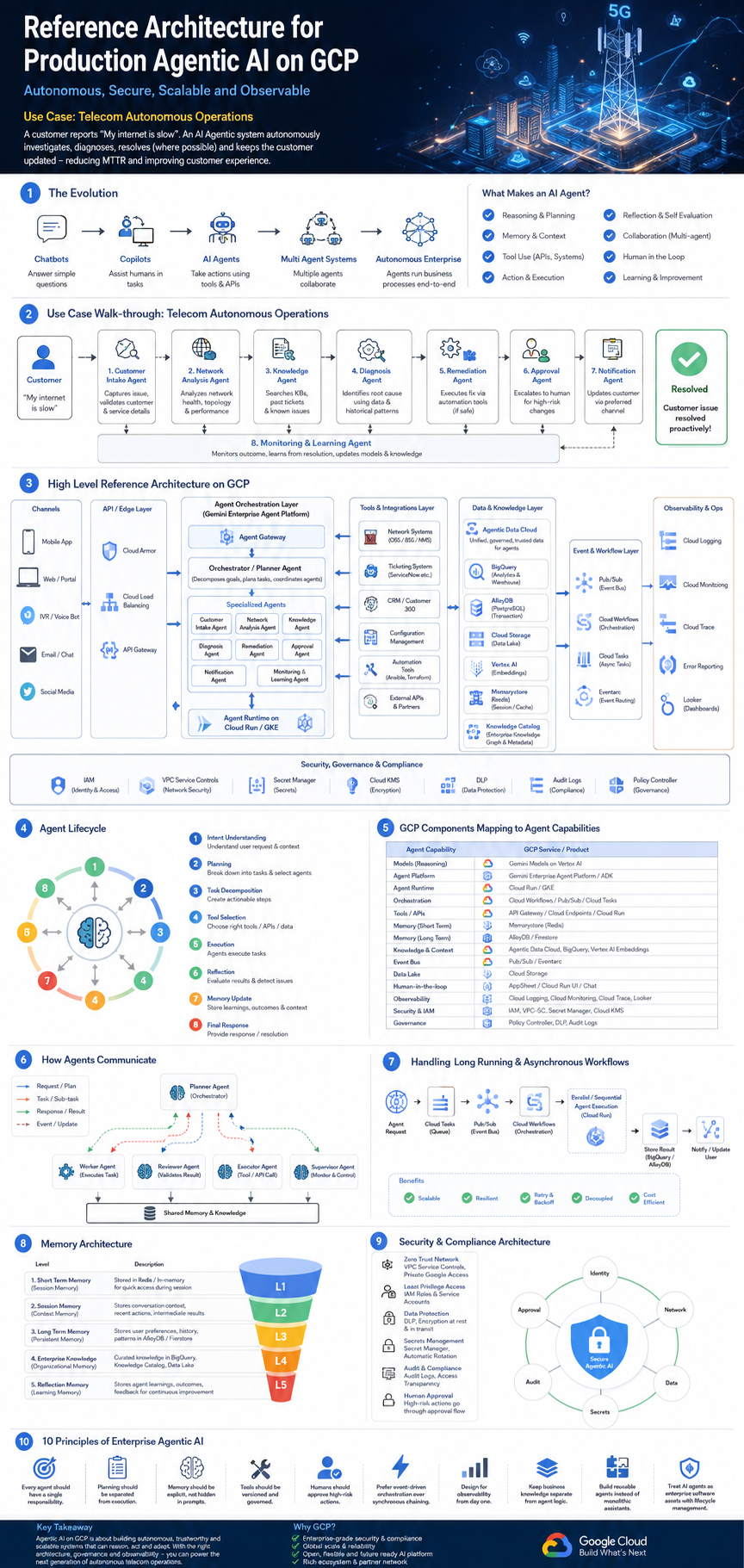
The accompanying reference architecture illustrates this operating model.
Rather than viewing it as a technology diagram, it should be understood as a blueprint for enterprise decision-making.
Each layer exists to answer a single architectural question.
Customer Interaction
The journey begins when a customer reports a service issue through any digital channel.
At this point the objective is not merely to understand the request but to capture sufficient business context for autonomous execution.
The Customer Intake Agent identifies the intent, validates customer identity, enriches contextual information, and prepares the request for downstream reasoning.
Planning and Orchestration
Instead of immediately invoking enterprise APIs, the request reaches the Planner Agent.
This represents one of the most important architectural shifts.
Rather than executing a predefined workflow, the planner decomposes the objective into smaller tasks, identifies which specialist agents should participate, coordinates dependencies, and determines the execution strategy.
Planning transforms AI from reactive conversation into autonomous problem solving.
Specialized Intelligence
No single agent owns the entire business process.
Instead, responsibility is distributed across domain-specific agents.
The Network Analysis Agent investigates alarms and topology.
The Knowledge Agent retrieves previous incidents, engineering documentation, and operational runbooks.
The Diagnosis Agent correlates technical evidence to identify the most probable root cause.
The Remediation Agent determines whether corrective actions can be executed automatically or require human approval.
The Notification Agent continuously communicates progress to the customer.
Finally, the Learning Agent records outcomes so future incidents benefit from accumulated operational experience.
Collectively these agents resemble a high-performing operations team rather than a conversational assistant.
Enterprise Knowledge
Enterprise knowledge is the foundation of trustworthy autonomous decisions.
Each agent combines real-time operational telemetry with historical incident data, topology information, configuration repositories, customer records, and documented engineering procedures.
Google Cloud services such as BigQuery, vector search, Firestore, AlloyDB, and enterprise data platforms provide the persistent knowledge layer that allows agents to reason beyond the immediate prompt.
Without enterprise knowledge, AI produces answers.
With enterprise knowledge, AI produces decisions.
Secure Execution
The architecture deliberately separates reasoning from execution.
Agents never modify production environments directly.
Instead, governed execution occurs through enterprise APIs, automation platforms, Cloud Run services, workflow engines, and existing operational systems.
High-risk changes introduce human approval before execution.
This separation improves auditability, governance, and operational trust.
Event-Driven Operations
Enterprise incidents rarely complete within seconds.
Network diagnostics, maintenance workflows, technician dispatch, and customer notifications are asynchronous processes.
Google Cloud Pub/Sub and Workflows provide the event-driven backbone that enables agents to collaborate over minutes or hours without maintaining long-lived sessions.
This architectural pattern improves resilience while supporting large-scale concurrent operations.
Continuous Learning
Every completed incident enriches the platform.
Successful remediation steps, operator feedback, approval outcomes, customer satisfaction, and operational metrics become organizational knowledge available to future agents.
Unlike traditional automation, the platform becomes more capable with every interaction.
Mapping the Architecture to Google Cloud
The platform intentionally separates business capability from cloud implementation.
| Business Capability | Google Cloud |
|---|---|
| Enterprise reasoning | Gemini models |
| Agent development | Agent Development Kit (ADK) |
| Agent runtime | Cloud Run or GKE |
| Enterprise memory | Firestore, AlloyDB, Memorystore |
| Knowledge layer | BigQuery, Vertex AI Vector Search |
| Event backbone | Pub/Sub |
| Workflow orchestration | Workflows |
| Secure integrations | API Gateway, Cloud Run |
| Identity and governance | IAM, Secret Manager |
| Observability | Cloud Logging, Monitoring, Trace |
This mapping reinforces an important architectural principle: cloud services are implementation choices, while agent responsibilities define the business architecture.
Design Principles for Production Systems
Several patterns distinguish production Agentic AI from demonstration projects.
- Design specialized agents with clear responsibilities rather than one monolithic assistant.
- Separate planning, reasoning, and execution into distinct architectural layers.
- Treat enterprise knowledge as a managed asset rather than embedding it in prompts.
- Prefer event-driven collaboration over synchronous agent chains.
- Introduce humans only where operational risk justifies intervention.
- Instrument every agent with comprehensive logging, tracing, and metrics.
- Apply least-privilege access to every tool invocation.
- Continuously learn from operational outcomes instead of static prompt engineering.
Closing Perspective
- The next generation of telecom operations centers will not be defined by larger language models.
- They will be defined by architectures that combine specialized reasoning, trusted enterprise knowledge, governed execution, and continuous learning into a single operating model.
- Google Cloud provides the building blocks, but architecture determines whether those components become another chatbot—or an autonomous enterprise capability.
- For technology leaders, the strategic question is no longer whether to adopt Agentic AI.
- It is how quickly they can redesign their operating model around it.
The reference architecture presented here offers one blueprint for that transformation.
Share this article