Navigating the Future of AI Agents: MCP vs. A2A vs. ACP vs. ANP
In the rapidly evolving world of AI, agents are no longer isolated entities—they're becoming interconnected systems capable of collaborating to solve complex problems. As we move from chatbots to autonomous agents handling real-world tasks, standardised communication protocols are becoming the critical "plumbing" for the agent era.
This article breaks down four protocols shaping the landscape:
- Model Context Protocol (MCP)
- Agent-to-Agent Protocol (A2A)
- Agent Communication Protocol (ACP)
- Agent Network Protocol (ANP)
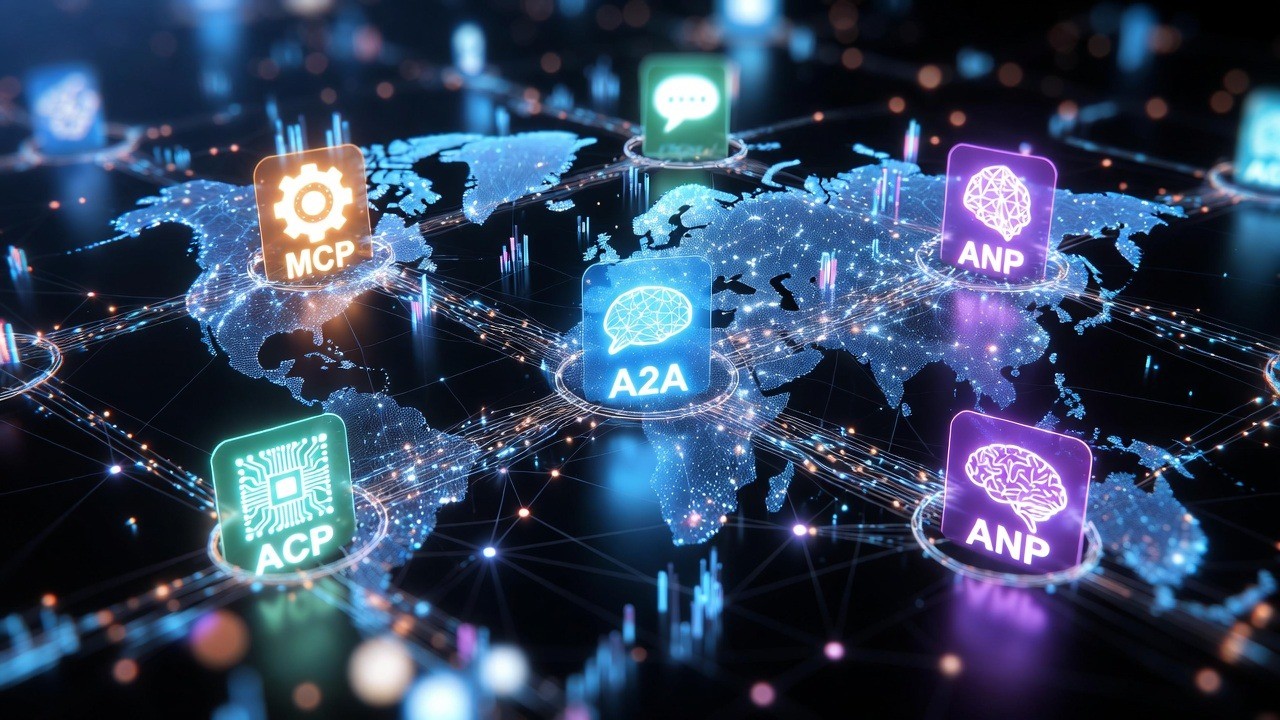
What Are These Protocols?
Think of these protocols as layers:
- MCP connects an LLM to tools and data.
- A2A connects one agent to another (often across vendors/platforms).
- ACP standardises agent collaboration via a REST-friendly interface (and can include humans/apps).
- ANP aims for internet-scale, decentralized agent networking (identity + negotiation + semantics).
Model Context Protocol (MCP)
Introduced by Anthropic in late 2024, MCP is an open-source standard that connects AI models to external data sources, tools, and workflows. It’s essentially a universal adapter for AI, allowing models to access real-time information without custom integrations. Built on JSON-RPC, it supports bidirectional communication, making it ideal for enhancing model capabilities dynamically.
Agent-to-Agent Protocol (A2A)
Launched by Google in April 2025 and governed by the Linux Foundation, A2A focuses on enabling AI agents to communicate and collaborate across platforms and vendors. It complements MCP by handling agent-to-agent interactions, using JSON over HTTP for task delegation, information exchange, and coordination. It’s built for enterprise-scale interoperability.
Agent Communication Protocol (ACP)
Developed by IBM’s BeeAI and hosted by the Linux Foundation, ACP is a REST-based protocol for connecting AI agents, applications, and even humans. It supports multimodal messages, synchronous/asynchronous modes, and streaming. ACP builds on ideas from MCP but emphasizes peer-to-peer agent collaboration.
Agent Network Protocol (ANP)
ANP aims to be the HTTP of the Agentic Web, enabling decentralized and secure communication among agents at internet scale. It features a three-layer architecture: identity (e.g., W3C DID), meta-protocol negotiation, and application layers for semantic interactions.
Real-World Use Cases and Adoption
MCP in Action
Claude + MCP can access tools like Google Calendar or Notion for personalized assistance. Databricks integrates it for enterprise chatbots querying multiple databases. Developers build MCP servers for custom workflows (e.g., generating apps from Figma designs).
A2A at Work
In cross-platform coordination scenarios (e.g., purchasing concierge), one agent researches products while another handles workflows and payment tasks across systems. Linux Foundation governance has accelerated adoption.
ACP Applications
ACP is used to connect multiple agents in IDEs for real-time collaboration. It supports streaming responses and async workflows (useful for document intelligence and internal enterprise automation).
ANP Innovations
ANP fits decentralized AI networks where agents share knowledge securely without central control. It’s being explored for “internet of agents” setups across research and edge/IoT scenarios.
Comparison Table
Here’s a side-by-side way to think about how they fit together.
| Protocol | Primary purpose | Best for | Notes |
|---|---|---|---|
| MCP | Model ↔ tools/data connectivity | Grounding, retrieval, tool execution | Acts like a universal adapter for context + tool access |
| A2A | Agent ↔ agent communication | Cross-vendor multi-agent workflows | Good for delegation, coordination, interoperability |
| ACP | REST-based collaboration for agents/apps/humans | Enterprise agent orchestration + streaming | Supports multimodal + sync/async + streaming patterns |
| ANP | Internet-scale, decentralized agent networking | Open agentic web, decentralized trust/identity | Identity + negotiation layers make it suitable for large networks |
Key Takeaways
- Choose based on scale: MCP for tool access; A2A/ACP for multi-agent collaboration; ANP for decentralized, internet-scale networks.
- Interoperability matters: protocols reduce vendor lock-in and let you mix ecosystems.
- Adoption is accelerating: Linux Foundation involvement + open-source momentum is pushing standardization.
- Security and decentralization are key: identity and trust become first-class concerns as agents network.
- The future is multi-protocol: combine them (e.g., MCP for tools + A2A for agents) for robust systems.
As AI agents become ubiquitous, mastering these protocols will give you a competitive edge. What’s your take—have you built with any of these?
Share this article


Recent Posts

The Agentic Shift: Moving from Chatbots to Digital Coworkers
By 2026, enterprises are moving from AI chatbots that answer questions to digital coworkers that own outcomes across end-to-end workflows.

The Future of Agentic AI in Enterprise Applications
Why the next 3–6 months will define enterprise AI leadership — and how product and technology leaders can prepare for agentic systems that plan, decide, orchestrate, and execute.

Integration Modernization: An Enterprise Strategy for the Connected Enterprise
A Strategic framework for CIOs, CTOs, and enterprise architects to modernize integration, reduce risk, and unlock connected enterprise velocity.

AI 101: Your Gateway to the World of Large Language Models
A practical, non-fluffy guide to AI and Large Language Models (LLMs) for developers, CXOs, and AI leaders—what they are, how they work, when to use which model, and how to get reliable answers.

Google Maps for Your Code: Rescuing Architecture with the C4 Model
How the C4 model turns messy architecture diagrams into a clear, zoomable map of your systems—so teams can align, migrate, and evolve faster.

The Iceberg Beneath Your Code: Understanding Tech Debt in Software Development
Tech debt is the hidden iceberg beneath your codebase—slowing teams, inflating risk, and threatening outages. Here’s how to see it clearly and pay it down strategically.

How Claude Code Turns Your Terminal into an Agentic Dev Team
Claude Code is a framework for composing terminal-native AI agents with subagents, skills, hooks, and plugins to automate real dev workflows with control and determinism.