The Iceberg Beneath Your Code: Understanding Tech Debt in Software Development
Imagine this: It's a crisp Monday morning in 2012 at Knight Capital Group, a powerhouse in algorithmic trading. The team deploys what should be a routine update to their trading software—a simple tweak to stay competitive in the high-stakes world of Wall Street. But within 45 minutes, chaos erupts. Faulty code from an obsolete system, buried deep in the codebase like a forgotten landmine, triggers billions of erroneous trades. By the time the panic button is hit, $440 million has vanished into thin air. Knight Capital teeters on the brink of collapse, acquired in a fire sale just days later. This wasn't malice or sabotage; it was tech debt—the insidious accumulation of shortcuts, legacy systems, and neglected maintenance that sank a titan overnight.
This story isn't ancient history; it's a stark reminder that tech debt isn't just a buzzword for overworked developers. It's the silent killer lurking in every codebase, every pipeline, every team. In this article, we'll dive into the iceberg of tech debt: the visible tip of frustration and delays, and the massive, hidden bulk threatening to capsize your project. We'll explore its many faces, the catastrophic ripple effects of ignoring it, and a battle-tested strategy to claw your way back to solvency. Buckle up—because in software development, ignoring the depths can cost you everything.
TL;DR – Why this matters
Tech debt is not just messy code; it's an invisible iceberg under your roadmap. It slows every release, increases outage and breach risk, and quietly taxes your best engineers. This article helps you name the different kinds of debt, show leaders the real cost, and put a pragmatic repayment plan in motion.
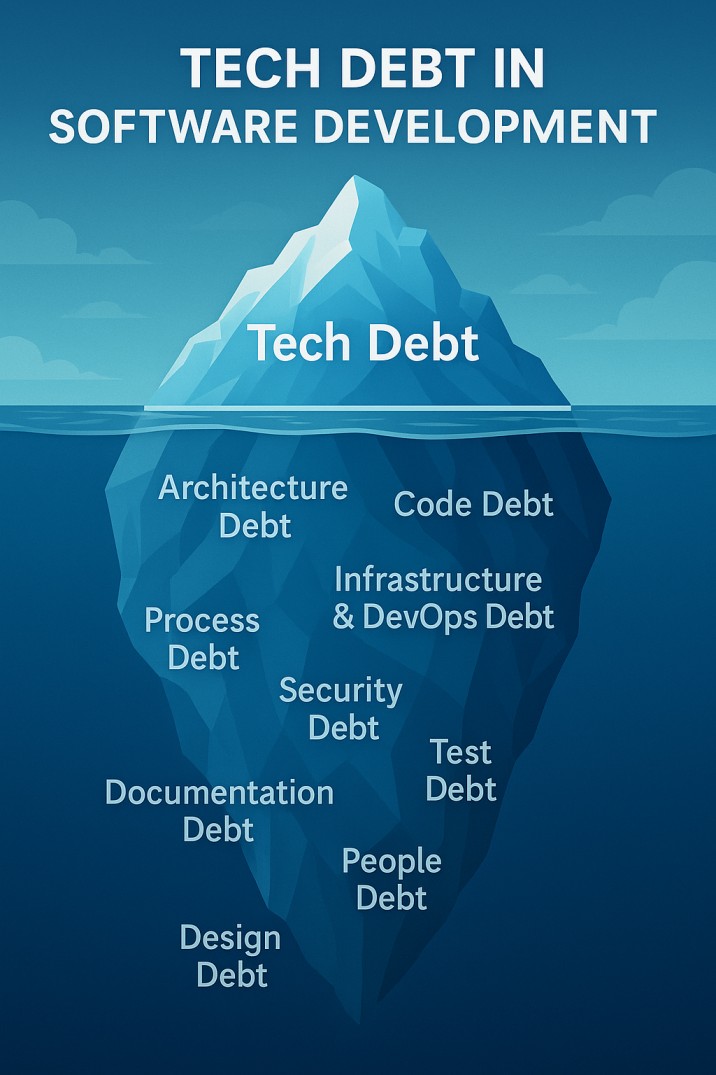
The Iceberg : What Lies Beneath the Surface
Picture an iceberg drifting toward your ship. The jagged tip above water? That's the immediate pain—bugs that crash your app, deployments that drag on for hours, or features that take twice as long to build. It's what stakeholders see and complain about: "Why isn't this working faster?"
But submerged, vast and unseen, is the tech debt—the 90% you can't spot until it's too late. This hidden mass includes brittle architectures, untested code, outdated tools, and processes that stifle innovation. Just like the Titanic's crew dismissed the berg as a minor hazard, teams often patch the surface while the depths erode velocity, security, and morale. The result? A sudden collision: outages, breaches, or burnout that sends talent fleeing.
The analogy drives home a key truth: Tech debt isn't "done on purpose" once—it's a compounding interest loan from your future self. As Martin Fowler, the godfather of refactoring, puts it: "The only way to go fast is to go well." Ignore the iceberg, and you're not just slow; you're adrift in frozen waters.
The Many Faces of Tech Debt: Beyond Code to the Entire Ecosystem
Tech debt isn't monolithic—it's a hydra with heads in every corner of your development lifecycle. Below, we'll break down the major types, with real-world ties where they sting the most. (Pro tip: If you're auditing your own stack, start here—it's a wake-up call.)
| Type of Tech Debt | Description | Real-World Pitfall |
|---|---|---|
| Architecture Debt | When foundational designs become rigid or misaligned with evolving needs, like a monolithic app that can't scale. | Netflix's early monolith struggles led to microservices migration—delaying "House of Cards" launch by months. |
| Code Debt | Messy, duplicated, or unoptimized code (e.g., "spaghetti code") that works but is a nightmare to maintain. | The Knight Capital glitch: Legacy order-routing code from 2003 exploded in a modern trading frenzy. |
| Infrastructure & DevOps Debt | Outdated servers, brittle CI/CD pipelines, or manual deployments that bottleneck releases. | Equifax's 2017 breach stemmed partly from unpatched Apache Struts—old infra left doors wide open. |
| Process Debt | Inefficient workflows, like ad-hoc code reviews or siloed teams, slowing collaboration. | Google's "20% time" evolved from process debt in rigid structures, fostering innovation like Gmail. |
| Security Debt | Skimped-on safeguards, such as weak encryption or ignored vulnerabilities. | SolarWinds hack (2020): Supply-chain compromises exploited rushed, unvetted updates. |
| Documentation Debt | Missing or stale docs, leaving new hires (or even veterans) guessing at how things work. | Every open-source project's nightmare—abandoned READMEs that scare off contributors. |
| People Debt | Skill gaps, burnout, or knowledge silos where key expertise isn't shared. | Twitter's 2022 layoffs amplified "bus factor" risks, where one departure crippled tribal knowledge. |
| Design Debt | Subpar UI/UX that frustrates users, like clunky interfaces built for speed over usability. | MySpace's fall: Flash-heavy designs became unusable on mobile, ceding ground to sleek Facebook. |
| Test Debt | Insufficient unit/integration tests, leading to fragile releases. | The Heartbleed bug in OpenSSL (2014): No robust testing exposed millions to data theft. |
| Data Debt (Bonus: Often Overlooked) | Poor data quality, schema mismatches, or unoptimized queries bloating costs. | Uber's early data silos caused compliance headaches during GDPR rollout. |
| Quality Debt (Another Gem) | Broad neglect of non-functional requirements like performance or accessibility. | Yahoo's ad platform crashes in 2013—quality lapses eroded trust and revenue. |
These aren't isolated; they compound. A dash of code debt today balloons into architecture woes tomorrow. The key? Recognize them early—tools like SonarQube for code or GitHub's dependency graph can surface the rot.
The Crushing Impact: Why Ignoring Tech Debt is a Sinking Ship
Sweep tech debt under the rug, and it doesn't stay buried—it festers. Here's the fallout, backed by cold stats:
Where the iceberg hits hardest
- Velocity Killer: Teams spend 40-80% of time on maintenance (per Atlassian's State of Teams report), turning sprints into firefighting marathons.
- Cost Explosion: Gartner estimates tech debt costs enterprises $500B+ annually in rework and lost productivity.
- Security Nightmares: Unaddressed debt fuels 60% of breaches (Verizon DBIR), eroding customer trust—like Target's 2013 breach from unpatched HVAC systems.
- Scalability Stranglehold: What scales to 1,000 users chokes at 1M, as seen in Roblox's 2021 outages from legacy infra.
- Talent Drain and Morale Dip: Developers hate wading through cruft—Stack Overflow's survey shows 70% cite "legacy code" as a top frustration, driving turnover.
- Innovation Freeze: Resources tied to fixes mean no room for new features, stifling growth in a world where speed wins (hello, TikTok vs. legacy media).
In Knight's case, the debt wasn't just financial—it was existential. Multiply that by your org's scale, and it's clear: Tech debt isn't a "later" problem; it's the barrier between thriving and surviving.
Charting a Course: A Strategy to Conquer Tech Debt
The good news? Tech debt isn't inevitable doom—it's repayable with discipline. Here's a phased strategy, inspired by Ward Cunningham (tech debt's coiner) and modern practices like those at Basecamp:
- Assess the Damage (Audit Phase)
- Run automated scans (e.g., CodeClimate for code, Snyk for security).
- Survey the team: "What's the one thing slowing you down?"
- Quantify with metrics: Cyclomatic complexity, deployment frequency, MTTR (Mean Time to Recovery).
- Prioritize Ruthlessly (Triage Phase)
- Use the "debt quadrant": High-impact/low-effort first (e.g., quick security patches).
- Adopt the Boy Scout Rule: Leave code better than you found it—no big bang refactors.
- Allocate "debt days": 20% of sprint time for repayment, à la Google's Innovation Time Off.
- Refactor with Purpose (Repayment Phase)
- Break monoliths into services (Strangler Pattern).
- Automate the boring: Shift-left testing, IaC with Terraform.
- Document as you go—tools like Swagger for APIs.
- Build Debt-Resistant Habits (Prevention Phase)
- Foster a blame-free culture: Celebrate refactors as wins.
- Invest in people: Cross-training, pair programming to combat silos.
- Monitor continuously: Debt dashboards in Jira or Linear.
Real-world win: Etsy slashed deployment pain by embracing DevOps debt repayment, boosting releases from weekly to multiple daily—unlocking $100M+ in revenue.
Track progress with a simple debt ratio: (Maintenance Time / Total Time) < 25%. Adjust as you sail smoother waters.
Final Thoughts: Surface the Iceberg Before It Surfaces You
Knight Capital's tragedy was a $440M iceberg collision—but yours doesn't have to be. Tech debt is the shadow side of innovation: Every shortcut has a shadow cost. By embracing the full iceberg view, dissecting its types, facing its impacts head-on, and charting a repayment strategy, you turn liability into leverage.
What's your tech debt story? Audit one type this week—start small, win big. After all, in software, the best ships aren't built to last forever; they're built to evolve.
Sources: Martin Fowler's "Refactoring," Gartner reports, Verizon DBIR, and developer surveys from Stack Overflow/Atlassian.
Share this article


Recent Posts

The Agentic Shift: Moving from Chatbots to Digital Coworkers
By 2026, enterprises are moving from AI chatbots that answer questions to digital coworkers that own outcomes across end-to-end workflows.

The Future of Agentic AI in Enterprise Applications
Why the next 3–6 months will define enterprise AI leadership — and how product and technology leaders can prepare for agentic systems that plan, decide, orchestrate, and execute.

Integration Modernization: An Enterprise Strategy for the Connected Enterprise
A Strategic framework for CIOs, CTOs, and enterprise architects to modernize integration, reduce risk, and unlock connected enterprise velocity.

Navigating the Future of AI Agents: MCP vs. A2A vs. ACP vs. ANP
A practical breakdown of the 4 key protocols shaping interoperable AI agents—what they do, where they fit, and how to choose (MCP, A2A, ACP, ANP).

AI 101: Your Gateway to the World of Large Language Models
A practical, non-fluffy guide to AI and Large Language Models (LLMs) for developers, CXOs, and AI leaders—what they are, how they work, when to use which model, and how to get reliable answers.

Google Maps for Your Code: Rescuing Architecture with the C4 Model
How the C4 model turns messy architecture diagrams into a clear, zoomable map of your systems—so teams can align, migrate, and evolve faster.

How Claude Code Turns Your Terminal into an Agentic Dev Team
Claude Code is a framework for composing terminal-native AI agents with subagents, skills, hooks, and plugins to automate real dev workflows with control and determinism.